Introduction
Building high-performance websites requires a deep understanding of frameworks and database interactions. Yii2, combined with PHP and MySQL, offers a powerful stack for creating scalable, maintainable web applications. However, mastering this trio demands more than basic knowledge—it involves best practices in architecture, security, and optimization.
At CodeCrafters, we refine our development process by leveraging Yii2’s advanced features and PHP’s flexibility, while optimizing MySQL queries for speed and reliability. This article presents practical insights and code examples that you can apply right away to improve your projects.
Structuring Yii2 Applications for Maintainability
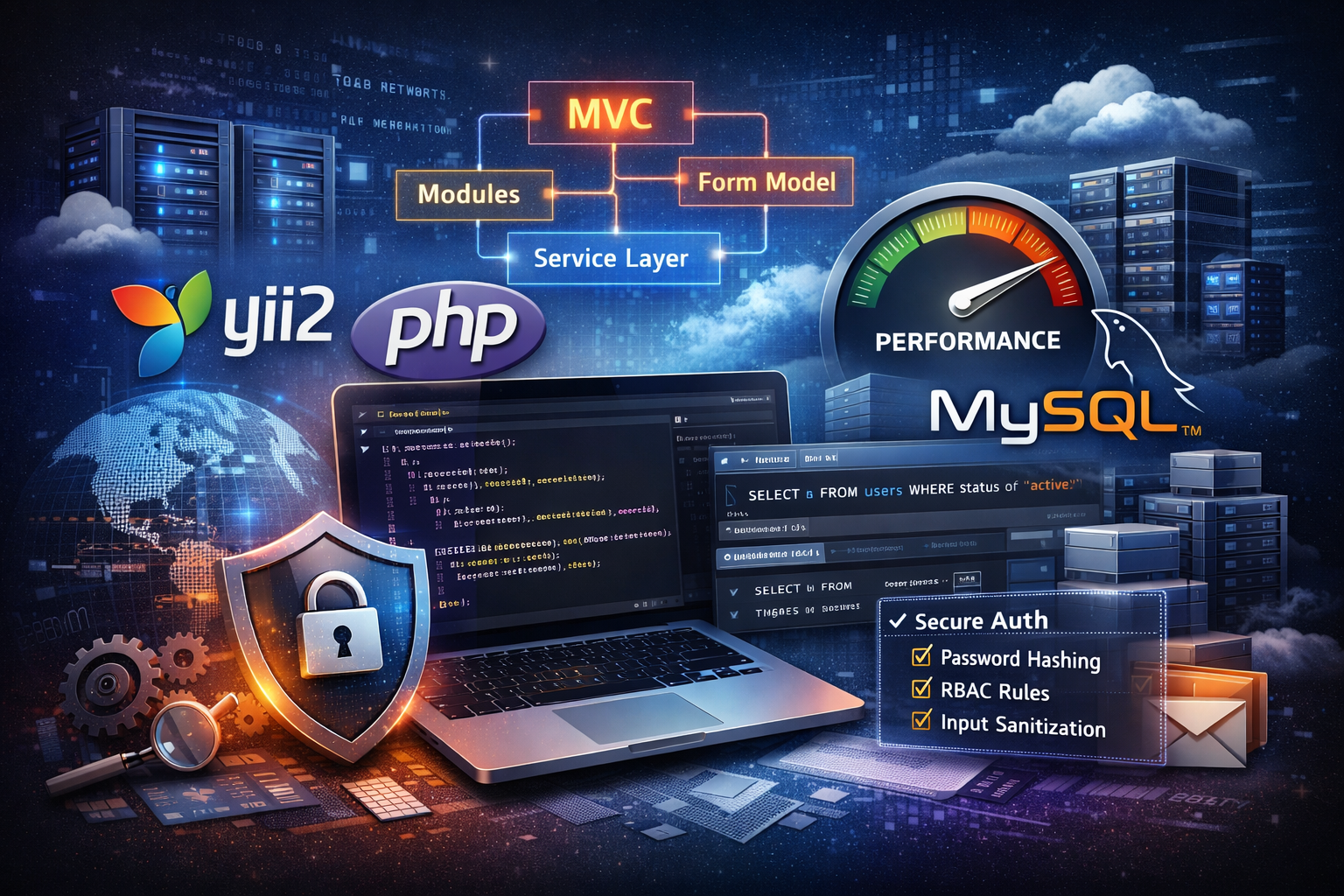
Well-organized code is essential for long-term project success. Yii2 encourages MVC architecture, but structuring beyond the basic separation can enhance clarity.
- Modules: Break down your application into modules for reusable, logically grouped components.
- Service Layer: Introduce service classes to handle business logic separately from controllers and models.
- Form Models: Use dedicated form models for user input and validation, keeping your ActiveRecord focused on database interactions.
Example: Creating a simple service to handle user registration logic.
namespace app\services;

use app\models\User;

class UserService
{
    public function register(array $data)
    {
        $user = new User();
        $user->attributes = $data;
        if ($user->validate() && $user->save()) {
            return $user;
        }
        return null;
    }
}
Optimizing MySQL Queries in Yii2
Unoptimized queries can cripple website responsiveness. Yii2’s ActiveRecord is convenient but can generate inefficient queries if misused.
Tips for optimization:
- Use
select()to fetch only necessary columns. - Avoid N+1 queries by eager loading relations with
with(). - Index appropriate columns to speed up lookups.
- Use caching mechanisms where applicable.
Example: Eager loading products and categories to reduce queries.
$products = Product::find()
    ->with('category')
    ->where(['status' => 'active'])
    ->all();
Implementing Secure Authentication
Security must be integral from the start. Yii2 provides robust authentication features which you can extend.
- Use Yii2’s built-in
IdentityInterfacefor user identity management. - Hash passwords with strong algorithms like bcrypt.
- Enforce role-based access control (RBAC) for permissions.
Checklist for secure auth:
- [x] Store passwords using PHP’s
password_hash()function - [x] Validate user sessions with secure cookies
- [x] Restrict access based on user roles
- [x] Sanitize input to prevent SQL injection and XSS
Enhancing Performance with Caching and Queues
To scale, integrate caching layers such as Redis or Memcached for database results and partial page rendering.
Use Yii2’s queue extension to handle resource-intensive tasks asynchronously, like sending emails or processing images.
Testing and Debugging
Ensure code quality with Yii2’s unit and functional testing capabilities. Utilize built-in debug toolbar and logging to identify bottlenecks or errors early.
Conclusion
Leveraging Yii2 with PHP and MySQL demands attention to architecture, query optimization, and security. Applying these structured approaches and tools allows for scalable and maintainable web applications.
Ready to elevate your project with expert Yii2 development? Contact CodeCrafters to tailor a solution that drives performance and reliability for your website.